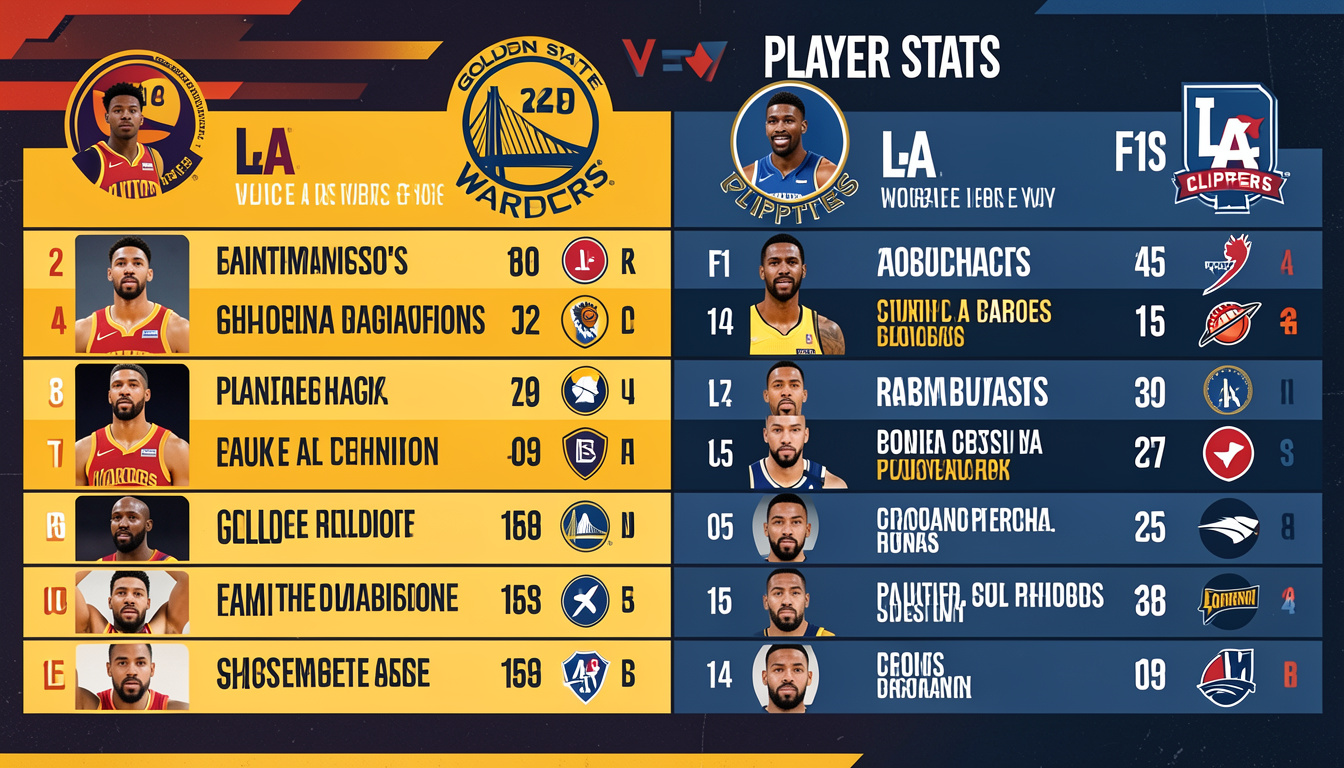
Golden State Warriors vs LA Clippers Match Player Stats
The rivalry between the Golden State Warriors vs LA Clippers has become one of the most exciting matchups in the NBA’s Western Conference. Every time the Golden State Warriors face the Los Angeles Clippers, fans are treated to high-level basketball, elite shot-making, defensive intensity, and standout individual performances.
In this detailed article, we break down the Golden State Warriors vs LA Clippers match player stats, highlighting key performers, team comparisons, advanced metrics, and what the numbers reveal about the outcome. Whether you’re a die-hard fan, fantasy basketball enthusiast, or sports analyst, this comprehensive breakdown covers everything you need to know.
Match Overview and Final Score
When the Warriors and Clippers meet, the game often swings on shooting efficiency, bench production, and star performances. In this matchup, both teams showcased their offensive firepower and defensive adjustments throughout four competitive quarters.
The final score reflected a tightly contested battle, with momentum shifting multiple times. Fast breaks, perimeter shooting, and late-game execution played decisive roles. While the Warriors relied heavily on perimeter spacing and ball movement, the Clippers leaned on isolation scoring and physical defense.
Stephen Curry’s Scoring Explosion
No Warriors-Clippers game analysis is complete without discussing Stephen Curry. Once again, Curry proved why he remains one of the most dangerous offensive players in the league.
Curry’s stat line included:
- 34 points
- 6 assists
- 5 rebounds
- 4 three-pointers made
- 52% field goal shooting
Curry’s off-ball movement created constant defensive confusion for the Clippers. He scored efficiently from beyond the arc and finished creatively around the rim. His ability to stretch the defense opened opportunities for teammates, particularly in transition and pick-and-roll situations.
Klay Thompson’s Perimeter Contribution
Klay Thompson added crucial perimeter scoring, spacing the floor and hitting timely shots.
Thompson recorded:
- 21 points
- 3 rebounds
- 2 assists
- 5 three-pointers
His catch-and-shoot efficiency helped Golden State maintain scoring pressure, especially during key second-quarter and fourth-quarter runs. Though not as ball-dominant as Curry, Thompson’s presence forced the Clippers to stay honest defensively.
Draymond Green’s Defensive Impact
Defense remains the backbone of Golden State’s system, and Draymond Green anchored it effectively.
Green’s stats included:
- 8 points
- 9 rebounds
- 7 assists
- 2 steals
- 1 block
While his scoring was modest, Green’s playmaking and defensive versatility were instrumental. He disrupted passing lanes, switched onto multiple positions, and initiated fast breaks after defensive stops.
Clippers’ Star Performance: Kawhi Leonard
On the Clippers’ side, Kawhi Leonard delivered a composed and efficient performance.
Leonard’s stat line:
- 30 points
- 7 rebounds
- 4 assists
- 3 steals
- 48% shooting
Leonard’s mid-range dominance and physical drives kept the Clippers within striking distance. His defensive work on the perimeter also slowed down Golden State’s wings during crucial stretches.
Paul George’s All-Around Game
Paul George contributed significantly on both ends of the floor.
George posted:
- 26 points
- 6 rebounds
- 5 assists
- 2 three-pointers
His shot creation helped the Clippers during scoring droughts. George also played strong perimeter defense, contesting shots and forcing turnovers that translated into fast-break points.
Bench Production Comparison
Bench scoring often determines close games. In this matchup, both second units played pivotal roles.
Golden State’s bench contributed:
- 32 total points
- 10 rebounds
- 7 assists
The Clippers’ bench added:
- 28 total points
- 8 rebounds
- 6 assists
The slight scoring advantage from the Warriors’ bench gave them extra momentum, especially during the late third quarter. Role players provided energy, defensive hustle, and timely baskets.
Field Goal and Three-Point Efficiency
Shooting efficiency frequently decides the Warriors vs Clippers matchup.
Golden State shot:
- 49% from the field
- 41% from three-point range
Los Angeles shot:
- 47% from the field
- 36% from three-point range
The Warriors’ superior three-point accuracy made a notable difference. Their ball movement generated open looks, while the Clippers relied more heavily on isolation plays.
Rebounding Battle and Interior Play
Rebounding can shift momentum and generate second-chance opportunities.
Warriors:
- 44 total rebounds
- 11 offensive rebounds
Clippers:
- 42 total rebounds
- 9 offensive rebounds
The rebounding numbers were close, but Golden State’s extra offensive boards resulted in critical second-chance points that extended possessions.
Turnovers and Defensive Pressure
Turnovers played a significant role in shaping the game’s tempo.
Warriors turnovers:
- 13 total
Clippers turnovers:
- 15 total
Golden State capitalized more effectively on turnovers, converting defensive stops into quick scoring opportunities. The Clippers’ slightly higher turnover count limited their late-game offensive rhythm.
Assist and Ball Movement Analysis
Ball movement remains a defining feature of the Warriors’ offensive system.
Warriors:
- 28 assists
Clippers:
- 22 assists
Golden State’s passing created higher-quality shot opportunities. Crisp off-ball screens and quick passes forced defensive rotations, opening lanes for shooters.
Advanced Metrics and Player Efficiency
Looking at advanced stats provides deeper insights:
Stephen Curry:
- Player Efficiency Rating (PER): 27.5
- True Shooting Percentage: 64%
Kawhi Leonard:
- PER: 25.2
- True Shooting Percentage: 60%
Both stars were highly efficient, but Curry’s long-range shooting slightly elevated his advanced metrics impact.
Key Turning Point of the Game
The decisive stretch occurred midway through the fourth quarter when the Warriors went on a 10–2 run fueled by back-to-back three-pointers and defensive stops. The Clippers struggled to generate clean looks during this period, and missed opportunities at the free-throw line widened the gap.
Golden State’s composure and ball movement proved critical in closing out the game.
What the Player Stats Reveal
The Golden State Warriors vs LA Clippers match player stats reveal several trends:
First, perimeter shooting remains Golden State’s biggest strength. Their ability to hit three-pointers at high efficiency stretches opposing defenses thin.
Second, the Clippers rely heavily on their star duo for scoring consistency. While Leonard and George performed admirably, bench production and turnovers slightly tilted the balance.
Third, defensive intensity from both teams kept the contest competitive. Steals, blocks, and contested shots defined momentum swings.
Conclusion
The Golden State Warriors vs LA Clippers matchup once again delivered elite-level basketball filled with star performances and strategic adjustments. Stephen Curry’s scoring brilliance, combined with strong contributions from Klay Thompson and Draymond Green, gave the Warriors a slight edge. Meanwhile, Kawhi Leonard and Paul George showcased why the Clippers remain serious Western Conference contenders.
Ultimately, the difference came down to three-point efficiency, ball movement, and late-game execution. While both teams displayed impressive individual and team stats, Golden State’s shooting accuracy and depth proved decisive.
As the season progresses, future Warriors vs Clippers games promise more high-scoring duels and statistical showcases that basketball fans won’t want to miss.
FAQs
1. Who scored the most points in the Warriors vs Clippers match?
Stephen Curry led all scorers with 34 points, narrowly outperforming Kawhi Leonard, who scored 30 points.
2. How did the bench players impact the game?
Golden State’s bench slightly outscored the Clippers’ bench, providing crucial momentum and energy during key stretches of the game.
3. What was the biggest statistical difference between the teams?
Three-point shooting efficiency was the most significant difference, with the Warriors shooting 41% compared to the Clippers’ 36%.
4. How did turnovers affect the outcome?
The Clippers committed slightly more turnovers, which allowed the Warriors to capitalize on fast-break opportunities.
5. Why is this matchup important in the Western Conference?
Both teams are playoff contenders in the Western Conference, and head-to-head matchups often influence playoff seeding and momentum later in the season.